

Gap Closer is an AI tool we built for affordable housing nonprofits in Orange County. It finds every program, lender, and past donor that may close a home's funding gap and drafts the asks. We estimate it saves about 62 staff hours and $2,200 per project, plus about $1,800 for every month the gap closes sooner.
The 45-second video below walks through one home, from address to drafted asks.
The Problem: Every Home Starts Six Figures Short
An affordable home has to balance one equation: what the family can pay, plus public subsidies, plus fundraising, has to equal what the home costs to create. The family's price is capped by their income. In Orange County, that leaves a gap of six figures on a typical home, and the nonprofit has to raise it.
The money exists, but it is scattered. Finance leads and development directors, often one or two people covering finance, fundraising, and grants at once, rebuild the funding plan by hand for every project:
- Searching federal, state, county, and city program sites one by one, each with its own rules and calendar.
- Checking whether income limits and program rounds are still current. California's 2026 income limits were revised on June 23, 2026, replacing the table published a month earlier.
- Remembering which donors gave in which city, and who was asked recently.
- Writing a fresh email or application for every source, mostly repeating the same project facts.
Every hour spent on that is an hour away from the donors, funders, and families the work is for.
The Impact: Time and Money Back
Here is our estimate for one project, using the example plan Gap Closer builds for a home in Santa Ana: 8 funding applications to prepare and 19 donors to contact.
| Task | Time saved per project | How we got it |
|---|---|---|
| Writing 8 applications | About 48 hours (32 to 64) | 10 to 20 hours per application, the most common answer in an Instrumentl survey of grant writers, cut by 40%, the time saving professionals saw on writing tasks with AI in a study published in Science |
| Searching for funders | About 11 hours (3 to 19) | In the same survey, 53% of grant writers need up to six days to find five good-fit funders. We scale that to the plan's 8 programs, count half of each day as searching, and count half of that time as saved, since staff still confirm each source |
| Writing 19 donor emails | About 3 hours (2.5 to 4) | 20 to 30 minutes per email, the length of the writing tasks in the Science study (which included grant cover letters and emails), cut by 40% |
| Total staff time | About 62 hours (38 to 87) | |
| Staff cost saved | About $2,200 ($1,300 to $3,000) | Those hours at $34.88, the national median hourly pay for fundraisers (BLS, May 2025), before benefits |
| Holding costs avoided | About $1,800 per home for each month the gap closes sooner | The example home carries $85,000 in holding costs (loan interest, taxes, insurance, management) over a typical four-year path from land to keys |
The estimate leaves some time out: looking up each donor's giving history, re-checking income limits and program deadlines, and keeping a tracker current. Real-world savings can also be smaller than in a study, since people still check every fact. A pilot will replace these estimates with measured numbers.
The biggest number is the last one. For a project of 4 to 12 homes, closing the gap even one month sooner is worth far more than the staff hours.
What Changes for the Team
Gap Closer puts the whole funding plan on one page.
- One clear number. The team sees exactly how much each home is short, and how that number moves when mortgage rates change.
- Every source in one place. Public programs, bonds, lenders, foundations, companies, and individual donors that may apply at that address show up together, each with a link to its source and the date it was checked.
- The right order. Sources are ranked by how much they are likely to bring in and how fast the money arrives, so the team starts early on slow programs and does not find a good fit after its deadline has passed.
- Warm donors first. People and organizations that already gave in the same city, or have ties to it, rise to the top. Asks stay modest and respect anyone who asked not to be contacted.
- Asks ready to send. Every donor email and first-pass application is drafted from the project's facts. The team edits, then sends from their own email.
The goal is simple: the gap closes sooner because the team pursues the right money earlier, misses fewer funding rounds, and spends more of its time on relationships.
One Home in Santa Ana
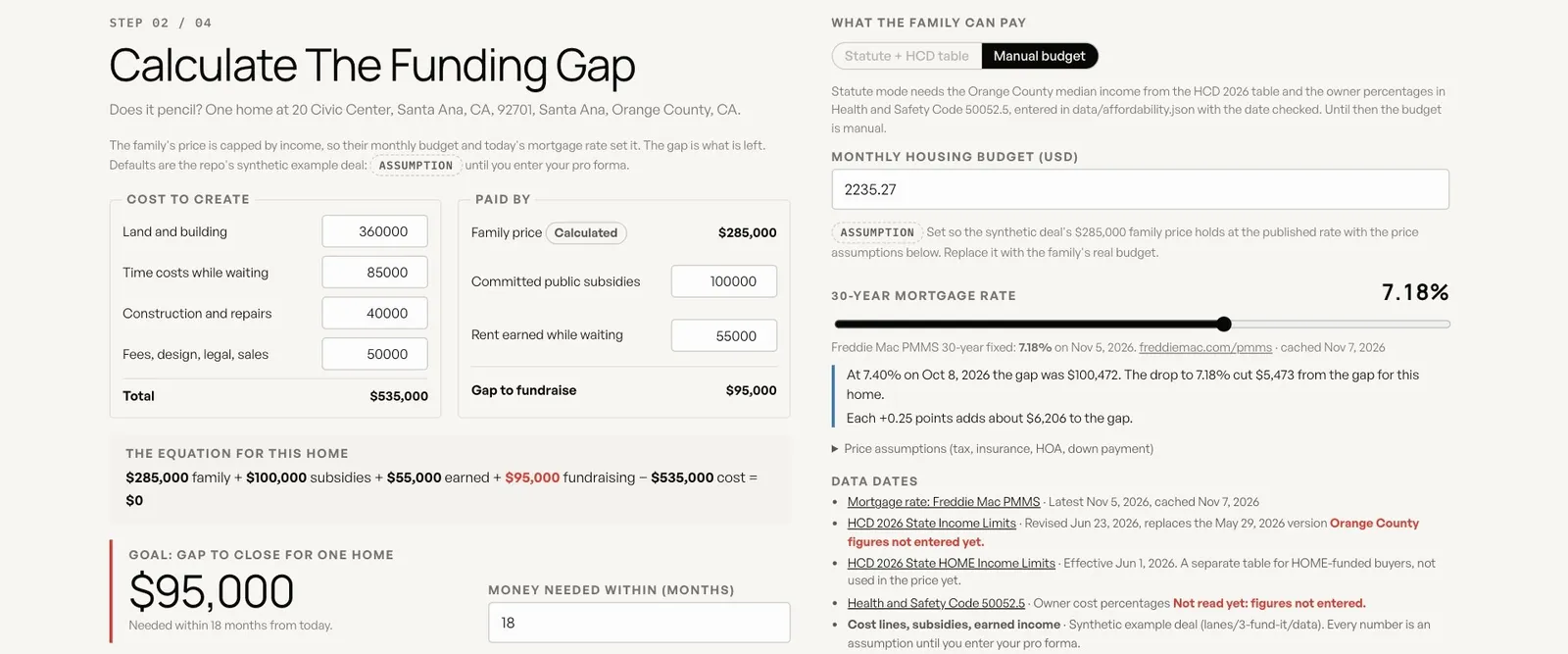
Here is the example home the tool walks through, with illustrative numbers:
| The home costs | It is paid by | ||
|---|---|---|---|
| Land and building | $360,000 | The family's price | $285,000 |
| Holding costs while waiting | $85,000 | Public subsidies | $100,000 |
| Construction and repairs | $40,000 | Rent earned while waiting | $55,000 |
| Fees, design, legal, sales | $50,000 | Fundraising: the gap | $95,000 |
| Total | $535,000 | Total | $535,000 |
The family's price depends on the mortgage rate, so the gap does too. When the Freddie Mac 30-year rate fell from 7.40% on October 8, 2026 to 7.18% on November 5, 2026, this home's gap shrank by about $5,500. Each quarter-point rise would add about $6,200. For a finance lead, "rates went up" becomes a dollar figure they can bring to the board or a funder.
People Stay in Charge
A wrong number in a grant application can cost a nonprofit credibility with a funder for years, so Gap Closer is built to be careful:
- It never sends anything. It drafts. A person reviews, edits, and sends from their own account.
- It shows its sources. Every program fact links to where it came from and when it was checked. When it does not know something, it says "unknown" instead of guessing.
- It leaves blanks for people to fill. Anything missing from a draft is marked in brackets, so no invented figure slips into an ask.
- The team has the final say. Any amount, chance, or timeline can be changed, and the plan updates right away.
What Comes Next
The biggest cost in this work is keeping program facts current, and every nonprofit pays it separately today. The next step is a shared library of Orange County housing programs, maintained once and used by everyone, with each amount and deadline dated and re-checked. From there, Gap Closer can connect to the donor database and email a team already uses, grow from one home to projects of 4 to 12 homes, and expand county by county across Southern California.
We are looking for an Orange County housing nonprofit to try it on a live project, measuring staff hours, missed rounds, and time to money against the way the team works today.
Want This for Your Organization?
If your team rebuilds the same funding plan for every project, we can help. We build custom AI systems for nonprofits, and it starts with an assessment of where your team's hours go. Before any donor data goes near an AI tool, your board will also want an AI usage policy.