Government procurement is a real revenue channel for small businesses, and it is gated by a research problem rather than a capability problem. The bids exist. Finding them is the job nobody has time for.
Public solicitations are published across dozens of disconnected agency portals, each with its own format, its own posting cadence, and its own PDF packet. A small contractor has two options: pay someone to watch all of those sources, or miss the work entirely. Most pick the second option by default.
We built FindBids to do that watching with AI.
The Problem: The Bids Are Public, But They Are Not Findable
The difficulty is not secrecy, it is fragmentation. Every agency runs its own portal. There is no single feed, no shared schema, and no consistency in how scope, deadlines, or eligibility requirements are described. The substance that decides whether a business should bid is buried inside an attached packet that can run to 90 pages.
So the cost of participating in public procurement is not the bid itself. It is the hours spent finding out whether a bid is worth writing.
What We Built
FindBids ingests new solicitations from those scattered sources, reads the documents, and matches them against a business's trade, service area, and past work. Three pieces do the work:
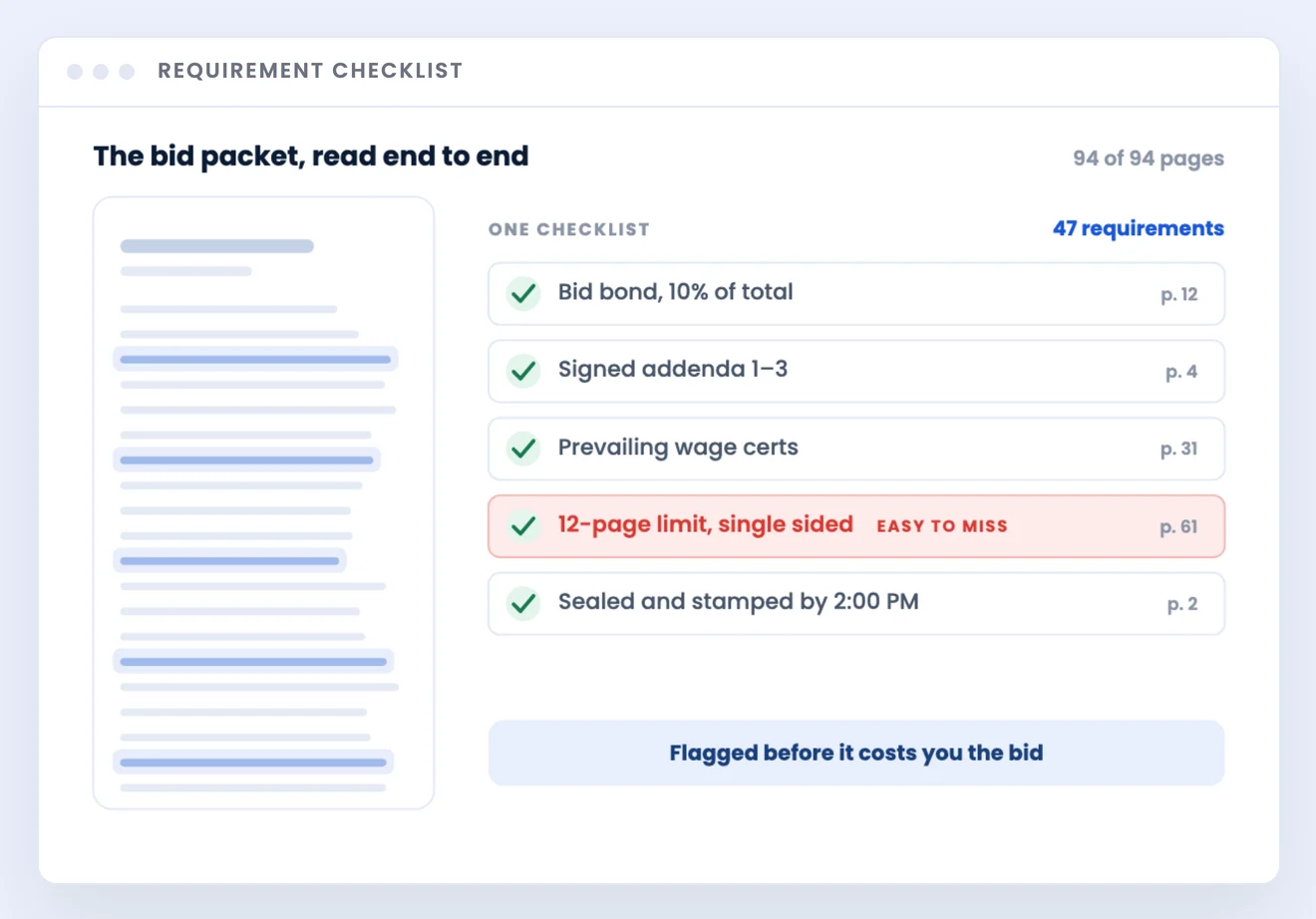
- AI parses each solicitation packet and pulls out the parts that matter for a bid/no-bid decision: scope of work, deadlines, and eligibility requirements.
- Matching narrows thousands of open bids down to the handful a specific business can realistically win, based on what that business actually does and where it operates.
- Owners read a plain-language summary instead of a 90-page PDF before deciding whether to pursue the work.
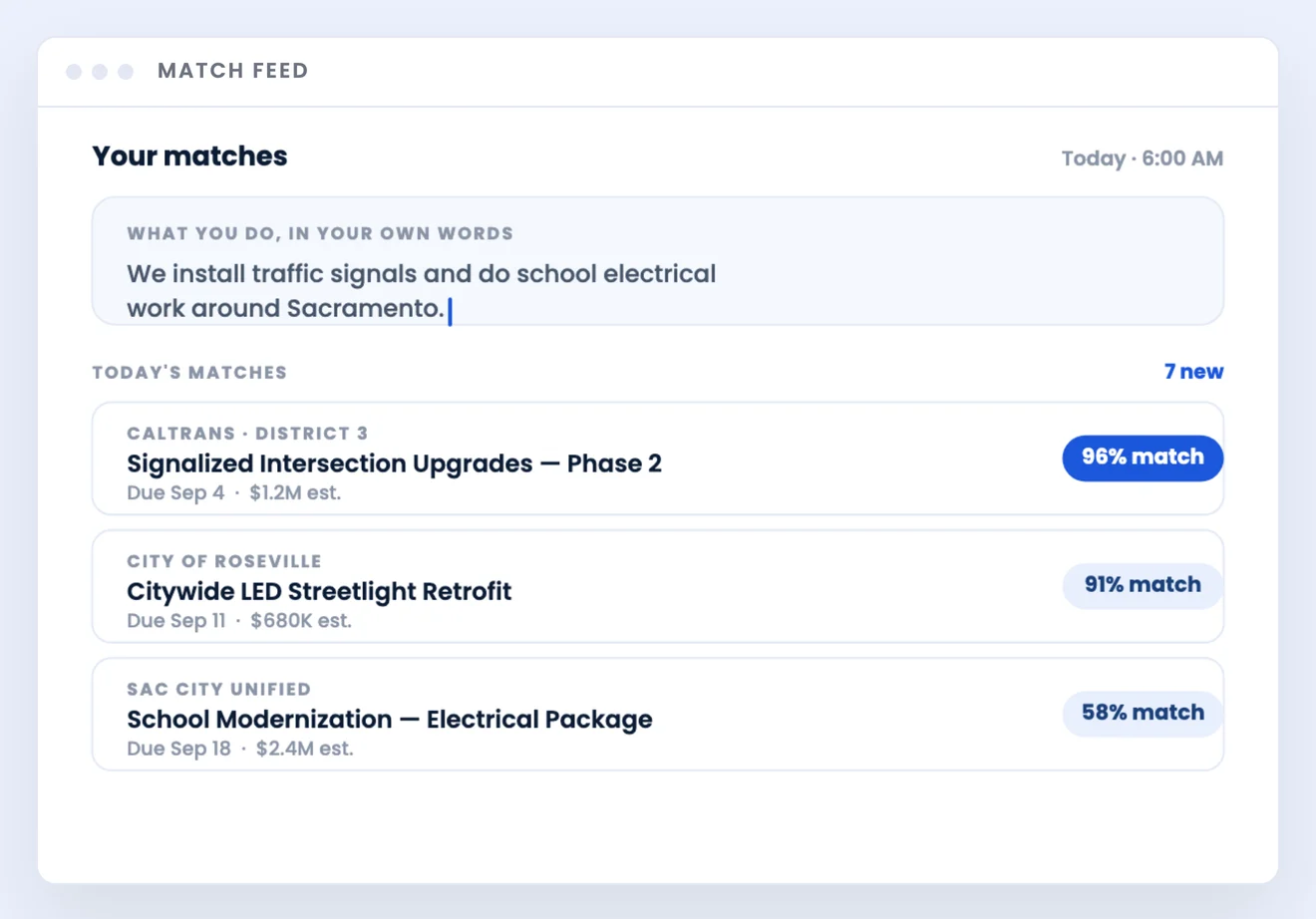
The order matters. Parsing has to come first, because matching on titles and category codes alone produces the same noise a keyword alert produces. Once the eligibility requirements and scope are extracted as structured data, matching can be strict without being brittle.
Why This Is a Custom System and Not a Tool Purchase
This is the shape of problem that off-the-shelf software handles badly. The source documents are unstructured and inconsistent, the matching criteria are specific to each business, and the output has to be trustworthy enough that an owner acts on it without opening the original packet.
That combination is what we mean by custom AI systems: ingest messy real-world documents, extract structure from them, and match that structure against how a particular business actually operates. Procurement is one instance. Anything where your team currently reads long documents to make a repeated judgment call is another.
For contractors, this sits alongside the other places AI earns its keep in the field. We cover that ground in AI for construction contractors, including bidding and estimating.
Once a Bid Is Worth Pursuing
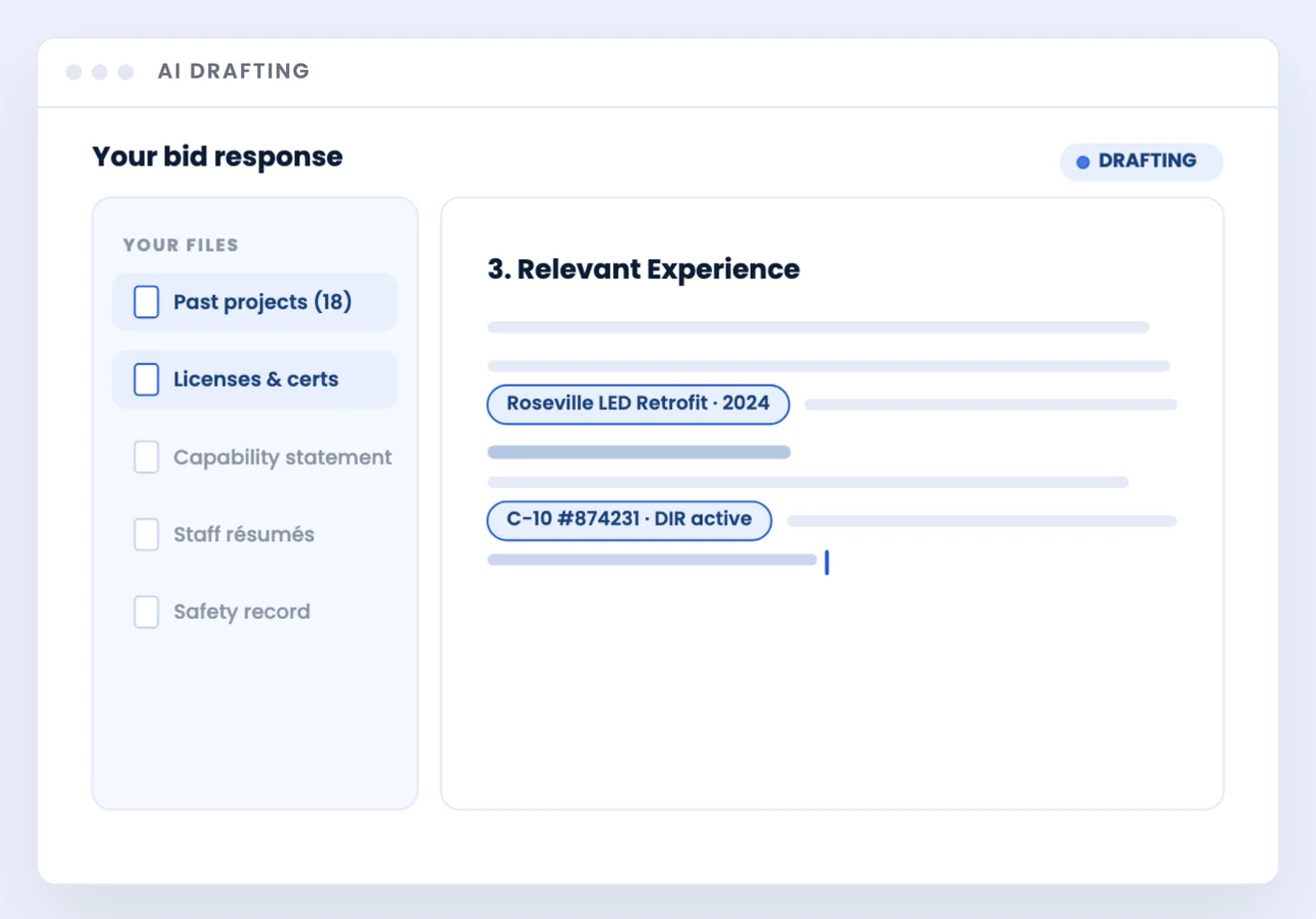
Matching and parsing decide whether to bid. The next bottleneck is writing the response, so the same extracted structure feeds a drafting step: the requirement list becomes the outline, and the business's own files, past projects, licenses, and certifications, get pulled in against the sections that ask for them.
The Result
Procurement research that used to eat a workweek becomes a short daily review. The bottleneck moves from finding and reading to deciding, which is the part an owner should be spending time on.
What to Take From This
If your team spends significant time reading documents in order to reach a routine decision, that is a workflow AI can compress, and it is worth measuring before you buy anything. A AI Strategy & Assessment maps where those hours actually go across your business and what to fix first. If the answer turns out to be a system nobody sells, we build that, scoped and quoted as project work, and you own what we deliver.
A fixed-price AI Strategy & Assessment starting at $2,500 shows you where AI fits your business, what it costs, and what it saves. Get a price range in two minutes, then book a 30-minute kickoff.